


gINKgo I RARE Hotels & Experiences Newsletter I The Unfamiliar Wild | VOL 129 | November 2026


Dear Travellers...
Every once in a while, if the entire industry were to look around, all kinds of travel and hospitality stand stereotyped, especially the special-interest ones, not so much in their subject but how they are narrated and presented as an experience. A sameness sets in; words become jargon. Wildlife tourism in India, tightly scheduled into its am-pm, wait-by-gates and drive-around-zones format, is now predictable but largely inefficient. Most importantly, it is phobic to the idea of a jungle – easy access, lodges designed as super-star stays, claiming predator sightings of all kinds for travellers seeking the predictability of a zoo while wanting the expanse of a forest, world-class cuisine and a multi-star resort experience. And the tacit compliance with lodges to come and do what you want – party, propose or marry in the jungles. No stops now that you have paid.
Imagine wildlife that slowly built itself to celebrate its naturalists and wilderness, focused on protection and resigned to challenges – mostly the whimsical regulatory changes of the Forest Department. The industry is actually grappling with the fact that wildlife that was once an adventure is now everything but! So, what could be the potential next shift? I don't know, and don't know many who have an assured answer. But living for long periods in the jungles of Bandhavgarh makes one acerbic to the idea of scheduled safaris on wheels. Maybe what looks like luxury in the forest would be deeper, closer and more personal. Not one that counts birds and mammals and the number of times one sees the numero uno of the Big Five, but feels their virility through mating calls, health through presence and proximity due to their comfort in the deep wilderness around. Of conversations around a small fire, sitting under inky skies among empathetic and curious travellers, alert to calls that pull you out of bed onto a deck or terrace or forest's edge. Not so much to see, but to know the forest is alive; species of birds and mammals, bugs and reptiles live a daily dance of survival in the forest, as it is a shared space.
So many of our lodges at RARE do not pass the present test of 'Luxury', nor do they aspire to. The love of wildlife is often tested by your effort and patience, and everything that is not just seeing something, and definitely not always through the echoing clatter of a long lens or lit on a smartphone.
One shouldn't miss the forests for the lodges.
Shoba Rudra
Storyteller & Boutique Hotels OG
The Bansa, Bandhavgarh, M.P
Bandhavgarh is special; it's where the first seeds of RARE were sown – an awe-struck and curious entrepreneur's first steps to understand why tourism powered by people and place is what the world would slowly but surely come to accept as the future. Which is why Sharad Vats' latest lodge, The Bansa, edging Bandhavgarh National Park, stands out in a location that gently delivers a remote forest experience.
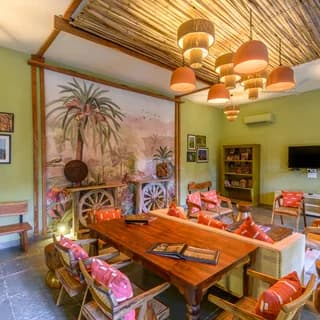
A private bungalow of six large rooms with floor-to-ceiling windows looking out to the 55 acres of wilderness around, The Bansa is built to give you a forest home, even for the shortest three days you book to stay. The central courtyard and the terrace on the floor above are a constant reminder of your residence close to the elements and their moods – sky, lakes, forest, day, night and seasons. A lounge and library on the same floor as the rooms are perfect for pre-dinner conversations. The courtyard offers private tables for breakfast and dinner, while the indoor dining area, equipped with an espresso machine, serves guests who prefer to stay indoors.
Long guided walks with your naturalist within the lodge premises along the park fence help you explore the forest on foot, often following alarm calls or mixed foraging parties of birds. The safaris to the Tala zone begin as a wilderness drive all along the way to the gate, creating opportunities for seeing birds, smaller mammals and the occasional cat or canid.
One of the most famous national parks in central India, Bandhavgarh has no dearth of lodges; many are cloistered around the village of Tala. The Bansa is among the few lodges focused on wildlife, with a window to the wild, ideal for longer stays, photography, forest walks, cycling and visiting villages.
Snow Leopard Lodge Opens in Mangyu, Ladakh
Mangyu Lodge opened for the winter on November 1, extending Snow Leopard Lodge's presence beyond Ulley and introducing a second setting from which to explore Ladakh's high-altitude wilderness. Situated within an apricot orchard, overlooking the valleys and cliffs of the Stok range, Mangyu comprises eight centrally heated, en-suite rooms designed for comfort essential in this trans-Himalayan landscape. Solar-powered operations, sensitive architecture, diverse local experiences through local employment is an approach where hospitality is considered alongside ecological responsibility and community engagement.
Accompanied by experienced trackers from the surrounding villages and equipped with world-class equipment, guests enter an environment shared by snow leopards, wolves, ibex and blue sheep. Open terraces and picture windows offer opportunities for observation, while the lodge is a retreat for this high-altitude exploration.
Ulley and Mangyu now constitute two distinct places to explore this remarkable wilderness, operational throughout the year. In summer they present the region through day hikes, wild flora, culture and outdoor camping. Wildlife and cultural interactions are central to the Snow Leopard Lodge's offering in Ladakh, through Ulley and Mangyu they invite a more considered understanding of the region, where the snow leopard is not merely as an elusive animal to be sought, but is an integral presence within one of the Himalaya's most extraordinary ecosystems.
Kipling Camp: A Forest Home
For over four decades, Kipling Camp, Kanha, Madhya Pradesh, has been part of central India's conservation landscape. Shaped by the family's vision for wildlife tourism and now under Belinda Wright's stewardship, it retains the intimacy of a private woodland home and a deep engagement with wildlife. Its charm lies in thoughtful comforts rather than conventional luxury.
Updated almost every off-season, the cottages recall old dak bungalows, each with a veranda sit-out. Colourful block printed linen and rugs, four poster large beds with mosquito nets, bath amenities, tea/coffee service trays with home-made cookies and reusable slippers lend them a personal character.
At the camp's heart, a chearful shamiana sits among sal trees, with books on its shelves and poetry on the walls. It is an inviting place for afternoon tea, with alarm calls, birdsong and wildlife activity beyond the clearing.
Belinda spends approximately ten months a year in the forest. Time with her offers an understanding of conservation beyond sightings and safaris: the wilderness, its vulnerabilities, and the patient work of protecting it.
The camp is home to Tara, the charismatic elephant who adopted it after traveling with Mark Shand, as recounted in his book Travels in My Elephant. Belinda supports Baiga families through education, school infrastructure, healthcare and community welfare. The camp's association with Gond art and Baiga dance sustains indigenous culture. Through the Wildlife Protection Society of India (WPSI), it works with forest-fringe communities to address human-wildlife conflict, explain compensation for crop and livestock losses, and combat poaching, recognising that conservation is inseparable from community well-being.
Kipling Camp is for all those who love the jungle and wish to spend time among those who have made it home. Its greatest distinction is that it wholly belongs to the forest.
A Living Landscape
Philippa Kaye's notes on the Terai
The Terai is an ecological continuum whose significance is scarcely contained by the political geography of India and Nepal. Its forests, grasslands and agricultural margins constitute a complex living mosaic, sustaining a remarkable interplay between wilderness, cultivation and human habitation. Yet this extraordinary landscape remains curiously peripheral to the larger discourse on wildlife travel.
This perspective emerged, to my amazement, during a recent journey from Kathmandu to Bardiya in Nepal, followed by a drive across the border into Dudhwa, Uttar Pradesh, where I stayed at Camp TigerLily,
The reintroduction of the one-horned rhinoceros, the extraordinary birdlife and the movement of elephants and tigers across this interconnected habitat speak of a conservation story of considerable consequence.
At Camp TigerLily, near Kishanpur Wildlife Sanctuary, the landscape's natural wealth resists the narrow vocabulary of wildlife sightings that has often defined my previous visits to jungles across India. The Terai reveals itself through a more expansive understanding of wilderness, where the relationship between species, habitats and human communities is as significant as the wildlife one might encounter.
Conversations with Jai, Camp TigerLily's wildlife scientist and naturalist, brought a deeper understanding of the region's conservation history and the delicate interdependence of its habitats and communities. Even with the national park yet to open for the season, at the time of my visit, Dudhwa offered an abundance of insight.
Camp TigerLily borders Kishanpur and tigers are known to roam the adjacent land. With just six rooms the feeling is of an intimate lodge where people come together over delicious meals to discuss the sightings of the day. With a choice of three parks the comparisons are varied and only add to the excitement for the next safari.